
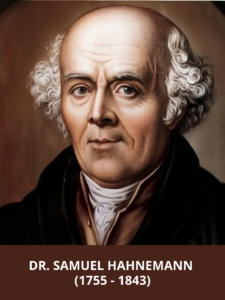
In an era dominated by “heroic medicine”, patients were routinely subjected to crude, barbaric, and unhygienic practices—massive bloodletting, agonising blistering, and the administration of toxic, unknown substances. For Christian Friedrich Samuel Hahnemann, a man of profound empirical rigour, to practise this “orthodox” medicine was not merely a professional failure; it was a moral catastrophe.
Hahnemann did not merely complain about the state of his craft; he chose the uncertainty of struggle. His journey from a learned yet disillusioned physician to a global medical reformer offers six counterintuitive lessons about the power of the sovereign mind and the courage required to spark a “regeneration in medicine”.
1. Linguistic Diversity as Research Power
Hahnemann’s revolutionary scientific insights were not born of medical school lectures, which he found riddled with “false suppositions and fancies”, but rather from his monumental capacity for language. By the age of 22, he had mastered Greek, Latin, English, Italian, Hebrew, Syriac, Arabic, Spanish, and German, and possessed a “smattering of Chaldaic.”
While serving in the secluded library at Hermannstadt, Hahnemann’s polyglot nature became his primary research engine. He bypassed the flawed translations of his peers to access ancient scientific literature directly. The culmination of this linguistic power was seen in his 1812 thesis on Hellebore, where he established his academic authority by quoting scores of ancient works in most European languages. As his early teacher, Master Muller—who taught him ancient languages and German composition—noted, the young Hahnemann possessed a “critical exposition of the old writers” that often surpassed that of his masters.
2. The Integrity to Walk Away
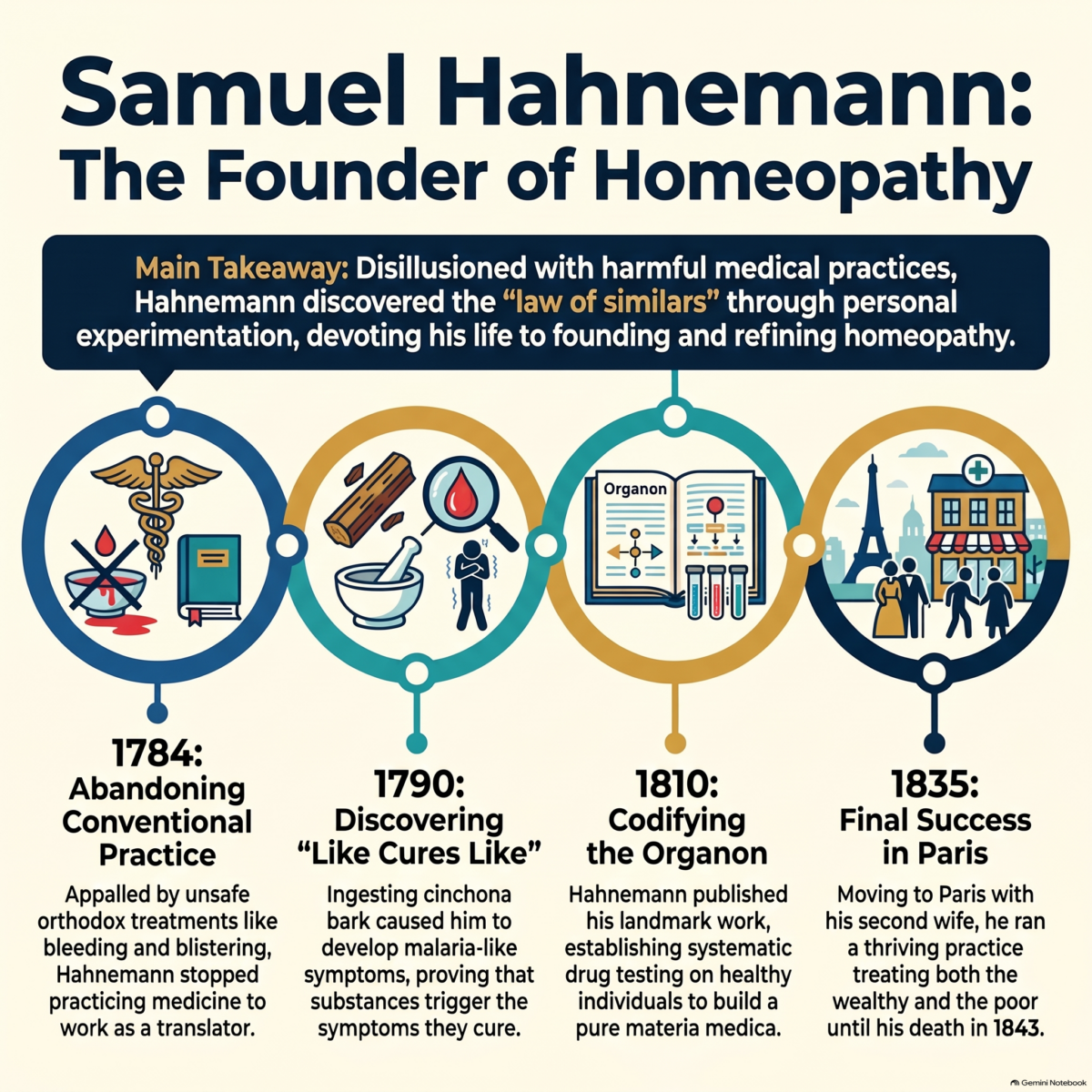
In 1782, shortly after his marriage to Johanna Kuchler, Hahnemann performed an act of radical professional honesty: he renounced the practice of medicine. He was “appalled” by the failure of conventional methods and the “arbitrary decision” that governed the use of medicines. He realised that the tools his teachers had given him would likely do more harm than good.
To support his large and growing family, he retreated into the gruelling world of chemistry and translation work. He chose to live as a scholar-in-exile rather than profit from a system he found abhorrent. In his now-famous “Letter to Hufeland”, he articulated the weight of this conscientious objection:
“To become, thus, the murderer or the tormentor of my brethren was to me an idea so frightful and overwhelming that soon after my marriage, I renounced the practice of medicine that I might no longer incur the risk of doing injury, and I engaged exclusively in chemistry and in literary occupations.”
3. Discovery Through Self-Experimentation: The Cinchona Moment
The year 1790 marked a paradigm shift in medical history. While translating Cullen’s Materia Medica, Hahnemann encountered the claim that Cinchona bark (quinine) cured malaria because of its “bitterness.” Rejecting this hollow hypothesis, he chose observation over theory. He performed a landmark experiment on his body, taking doses of the bark while in perfect health.
He was astonished to discover that the drug produced in him symptoms nearly identical to intermittent fever (malaria). This observation led to his “law of similars”—the realisation that a substance which cures a disease in the sick can produce symptoms of that same disease in the healthy. It was a move away from the “quagmire of textbooks” toward the “bright light of experience”, establishing a physiological doctrine of remedies based solely on experimental evidence.
4. The Family as a Living Laboratory
Hahnemann’s “rigorous plan” to rescue medicine required a dedication that merged domestic and scientific realms. His family home became a living laboratory for ‘provings’. He meticulously tested substances on himself, his friends, and his children, recording their effects with “rigorous exactness”.
The family members were not mere observers; they were participants in a new medical liturgy. Hahnemann sent them into the fields to collect henbane, sumach, and deadly nightshade, where they “felt the leaves, blossoms, and tubers with small but expert hands.” As historian Martin Gumpert observed, his children grew up as “young priests of the Asclepieion of Cos“. The family “huddled together” in their free moments, transforming their collective “flesh and blood” into the data points of a burgeoning science.
5. Intellectual Resilience Against “Medical Warfare”
The 1810 publication of the Organon of Rational Medical Science was a “signal for the commencement of violent warfare”. The medical establishment, led by virulent critics like Dr A. F. Hecker, responded with a flurry of polemics, labelling Hahnemann a “charlatan” and an “ignoramus”.
This conflict escalated sharply during his tenure at the University of Leipzig. Hahnemann was a “raging hurricane” in the lecture hall, delivering bitter, long-winded assaults on the medical mainstream. His “uncontrolled and fearless” style eventually drove his audience down to single figures, but the fatal blow was legal rather than academic. His enemies secured a “governmental decree about self-dispensing”, which barred him from preparing his medicines—the very heart of his practice. Despite being “neglected and avoided”, Hahnemann refused to stoop to replying to his “calumniators” in his own name, maintaining a focus on his work until he migrated to the safety of Köthen.
6. Success is a Late-Life Adventure
The final chapter of Hahnemann’s life serves as a testament to the longevity of the rebel spirit. At age 80, he entered a blissful second marriage with Melanie D’Hervilly Gohier, a French artist forty years his junior. Far from retiring, Hahnemann’s methodology continued to evolve; in his final years in Paris, he introduced “olfaction” (the smelling of remedies) and “liquid doses,” refining his system until his last breath.
The man who had been a medical pariah died in 1843 as a “celebrity and the preferred physician of the rich and famous”. Even as his physical frame grew “thinner and more dwarflike”, his intellectual stature only increased. As Gumpert described him in his final years, his “head, which increasingly dominated the body, remained erect and sovereign.”
Conclusion: The Sovereign Mind
Samuel Hahnemann’s legacy is not merely in the system of medicine he founded but in his refusal to “walk always in darkness”. He remains a towering figure of the “Sovereign Mind”—a physician who valued the evidence of his senses over the “uncertainty and empiricism” of his age.
His life poses a challenging question to any professional: do we have the courage to renounce the “orthodox” when it proves ineffective? Hahnemann’s journey suggests that the most profound advancements are reserved for those willing to follow the “bright light of experience”, no matter how far it leads them from the mainstream.
Learn more about homeopathic philosophy; join our courses here.