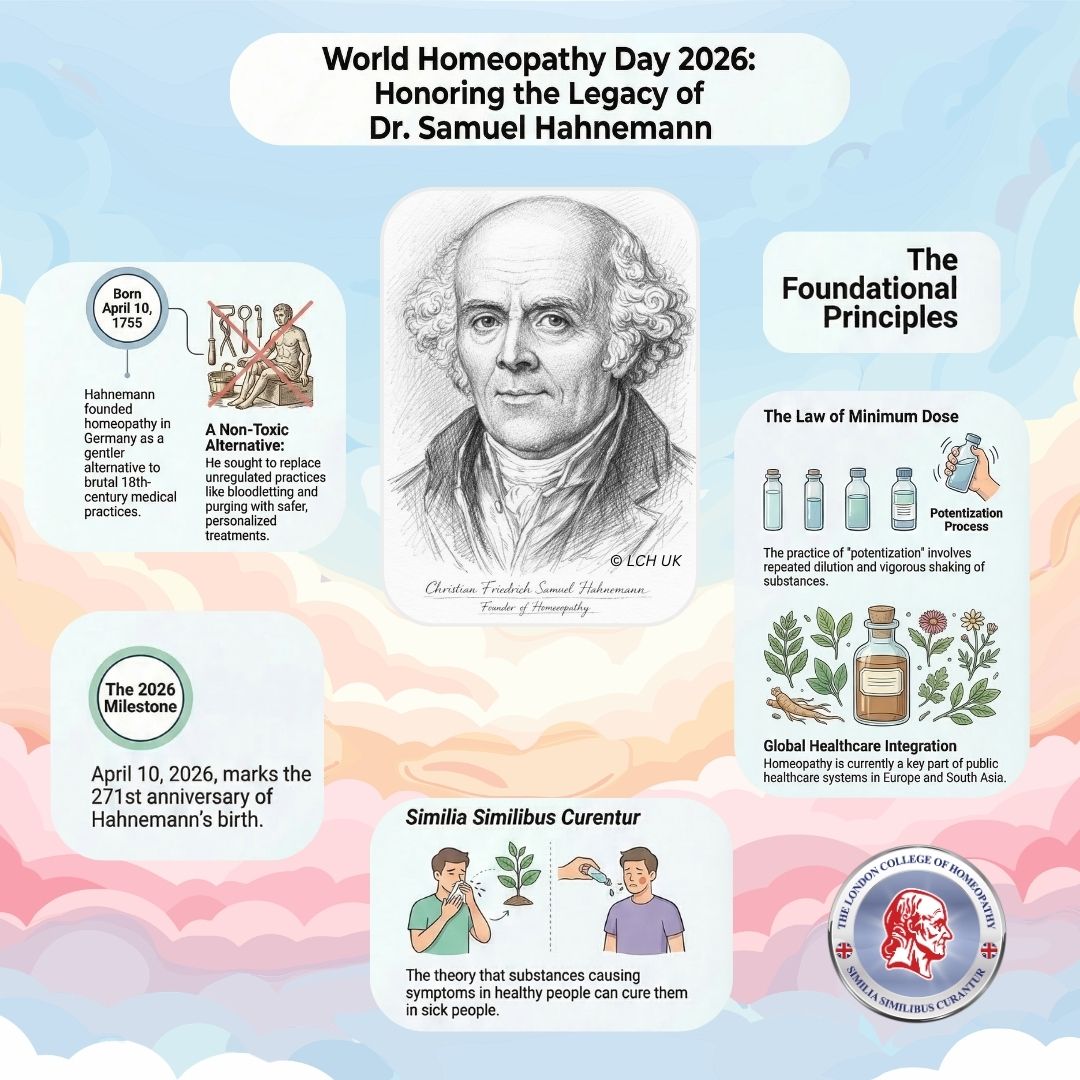
To understand the origins of homeopathy, one must first confront the visceral, often harrowing medical landscape of the late 18th century. It was an era defined by “heroic medicine”, a period where physicians frequently relied on bloodletting, aggressive purging, and the administration of toxic chemicals. For many patients, the cure was indistinguishable from the torture of the ailment itself.
It was within this brutal environment that Dr Christian Friedrich Samuel Hahnemann, a German physician and scholar born on April 10th, 1755, reached a discovery point of the most important medical and philosophical observations in the history of mankind. Deeply disillusioned by the medical standards of that era, Hahnemann did something radical for a man of his stature: he stepped away from his clinical practice and spent the following years working as a translator, using his linguistic skills to scrutinise medical texts. It was during this period of intellectual retreat that he formulated the dogmas that would eventually define a global movement.
On April 10, 2026, as the medical community observes the 271st anniversary of Hahnemann’s birth, which is celebrated worldwide as World Homeopathy Day, let us look beyond the controversies to the historical and modern significance of World Homeopathy Day.
1. Homeopathy Was Discovered as a Research-Orientated Science
Homeopathy did not emerge as a simple scientific discovery; it was a sophisticated answer against the invasive medical standards prevalent at that time. Hahnemann’s pivot to a “gentler approach” was revolutionary not because of its empirical weight, but because of its underlying philosophy of non-maleficence.
The historical transition from the 18th to the 19th century witnessed homeopathy offering a stark, non-toxic alternative and adjuvant to a mainstream medical world that was still struggling to understand disease in man (individualized approach). Hahnemann’s departure from the status quo was, at its heart, a humanitarian plea.
“Hahnemann believed that there are dynamic causes of the disease and we must understand an individual before offering him a treatment”
2. The Counter-Intuitive Logic of “Like Cures Like”
The foundational pillar of homeopathy is the principle of Similia Similibus Curentur, or “Let likes be cured by likes.” Introduced by Hahnemann in 1796, this cardinal principle explains that a substance that triggers specific symptoms in a healthy person can, when prepared homeopathically, treat those same symptoms in someone who is ill.
From the perspective of a science columnist, this logic is fascinatingly counterintuitive. This remains a cornerstone of the practice, challenging our standard medical narratives regarding how the body interacts with external remedies.
3. The Paradox of the Minimum Dose
Perhaps no aspect of homeopathy invites more scrutiny than the “Law of Minimum Dose”. Hahnemann theorised that the effectiveness of a remedy actually increases as its physical concentration decreases along with an increase in the potency, “power” or “dynamisation”. This led to the process of “potentisation”, involving repeated serially agitated dilution in water or alcohol accompanied by “succussion”—a method of vigorous shaking.
4. It’s a Global Integration, Not Just a Niche Practice
Today, in many countries, homeopathy still maintains a staggering global footprint, being a part of the public health care system, where it is deeply woven into the public healthcare infrastructure and holds a significant presence amongst the population.
In these regions, the conversation is less about the “why” and more about the “how”—specifically, how to provide affordable, holistic treatments to massive, diverse populations who rely on integrated health systems for their primary care.
5. The 2026 Focus is on Standardization, Not Just Tradition
The 271st anniversary of Hahnemann’s birth marks a fascinating pivot point for the homeopathic community. Rather than merely looking backward at tradition, World Homeopathy Day 2026 is being used as a platform for rigorous professional advocacy. Organisations are increasingly pushing for “better standardisation”, quality control, and higher educational requirements.
There is a poetic symmetry here. Hahnemann’s original 18th-century research into the system was directed to offer a safe, effective and affordable system of medicine. Today, the homeopathic community is coming full circle, advocating for its own strict regulations and safety protocols to ensure patient protection in a modern, highly regulated healthcare dialogue, making it available to the masses and being practised as a part of the public health care system.
Conclusion: The Future of Integrative Wellness
The enduring appeal of homeopathy lies in its focus on the personalised and the non-invasive. As we reflect on the evolution of healthcare since 1755, we see a path that has led from a physician’s quiet disillusionment to a global annual observance.
World Homeopathy Day 2026 prompts us to consider the shifting nature of medical truth. It invites a vital, inquisitive question for any observer of science and health: as our own technologies and treatments continue to advance. The search for more humane, effective healing remains constant, even as the methods continue to stir the world.