The Physician Who Quit Medicine to Save It: 6 Surprising Lessons from the Life of Samuel Hahnemann

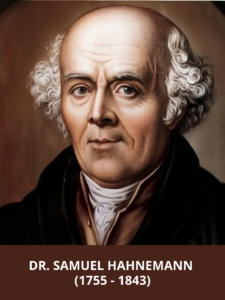
Samuel Hahnemann
Samuel Hahnemann

In an era dominated by “heroic medicine”, patients were routinely subjected to crude, barbaric, and unhygienic practices—massive bloodletting, agonising blistering, and the administration of toxic, unknown substances. For Christian Friedrich Samuel Hahnemann, a man of profound empirical rigour, to practise this “orthodox” medicine was not merely a professional failure; it was a moral catastrophe.

Hahnemann did not merely complain about the state of his craft; he chose the uncertainty of struggle. His journey from a learned yet disillusioned physician to a global medical reformer offers six counterintuitive lessons about the power of the sovereign mind and the courage required to spark a “regeneration in medicine”.

1. Linguistic Diversity as Research Power

Hahnemann’s revolutionary scientific insights were not born of medical school lectures, which he found riddled with “false suppositions and fancies”, but rather from his monumental capacity for language. By the age of 22, he had mastered Greek, Latin, English, Italian, Hebrew, Syriac, Arabic, Spanish, and German, and possessed a “smattering of Chaldaic.”

While serving in the secluded library at Hermannstadt, Hahnemann’s polyglot nature became his primary research engine. He bypassed the flawed translations of his peers to access ancient scientific literature directly. The culmination of this linguistic power was seen in his 1812 thesis on Hellebore, where he established his academic authority by quoting scores of ancient works in most European languages. As his early teacher, Master Muller—who taught him ancient languages and German composition—noted, the young Hahnemann possessed a “critical exposition of the old writers” that often surpassed that of his masters.

2. The Integrity to Walk Away

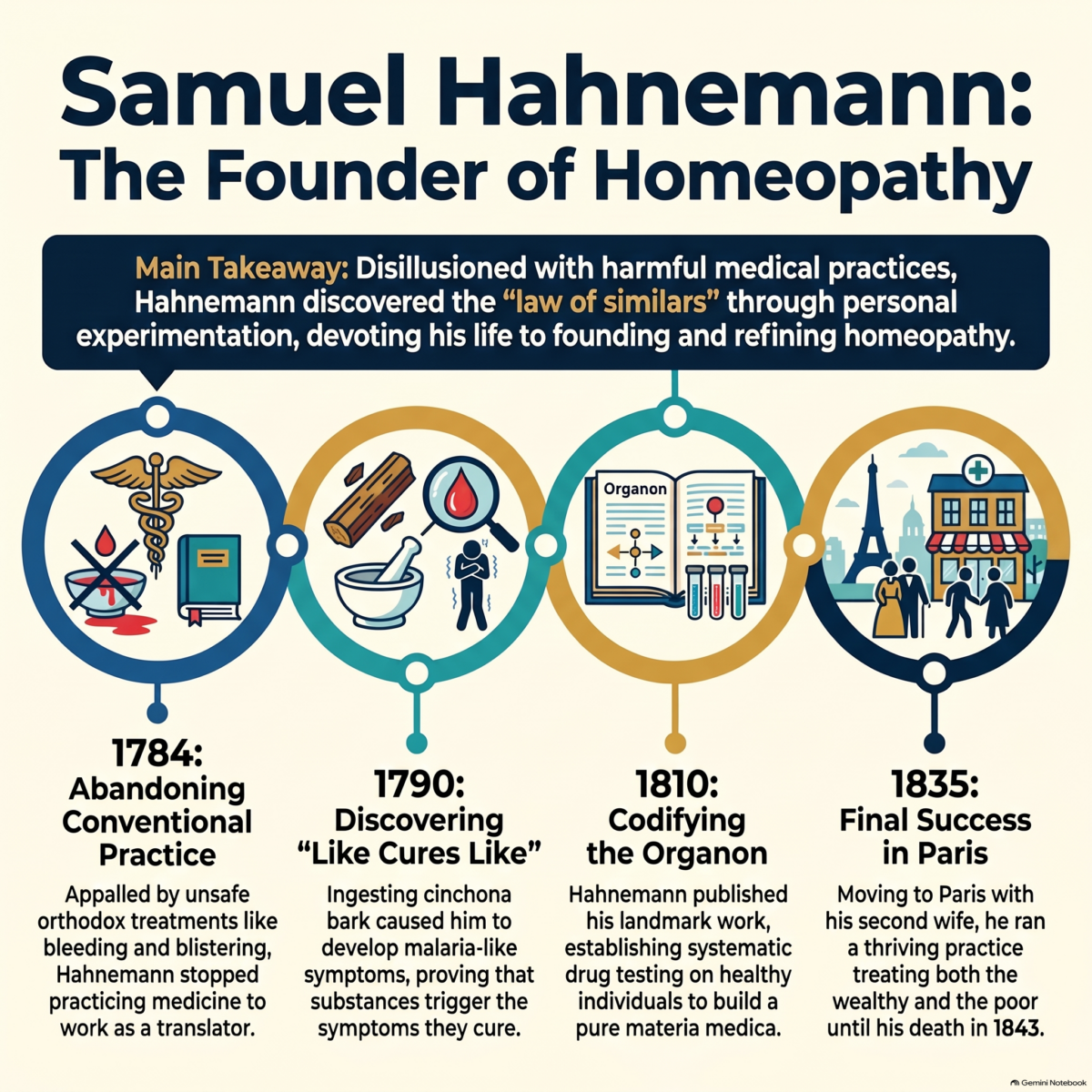
In 1782, shortly after his marriage to Johanna Kuchler, Hahnemann performed an act of radical professional honesty: he renounced the practice of medicine. He was “appalled” by the failure of conventional methods and the “arbitrary decision” that governed the use of medicines. He realised that the tools his teachers had given him would likely do more harm than good.

To support his large and growing family, he retreated into the gruelling world of chemistry and translation work. He chose to live as a scholar-in-exile rather than profit from a system he found abhorrent. In his now-famous “Letter to Hufeland”, he articulated the weight of this conscientious objection:

“To become, thus, the murderer or the tormentor of my brethren was to me an idea so frightful and overwhelming that soon after my marriage, I renounced the practice of medicine that I might no longer incur the risk of doing injury, and I engaged exclusively in chemistry and in literary occupations.”

3. Discovery Through Self-Experimentation: The Cinchona Moment

The year 1790 marked a paradigm shift in medical history. While translating Cullen’s Materia Medica, Hahnemann encountered the claim that Cinchona bark (quinine) cured malaria because of its “bitterness.” Rejecting this hollow hypothesis, he chose observation over theory. He performed a landmark experiment on his body, taking doses of the bark while in perfect health.

He was astonished to discover that the drug produced in him symptoms nearly identical to intermittent fever (malaria). This observation led to his “law of similars”—the realisation that a substance which cures a disease in the sick can produce symptoms of that same disease in the healthy. It was a move away from the “quagmire of textbooks” toward the “bright light of experience”, establishing a physiological doctrine of remedies based solely on experimental evidence.

4. The Family as a Living Laboratory

Hahnemann’s “rigorous plan” to rescue medicine required a dedication that merged domestic and scientific realms. His family home became a living laboratory for ‘provings’. He meticulously tested substances on himself, his friends, and his children, recording their effects with “rigorous exactness”.

The family members were not mere observers; they were participants in a new medical liturgy. Hahnemann sent them into the fields to collect henbane, sumach, and deadly nightshade, where they “felt the leaves, blossoms, and tubers with small but expert hands.” As historian Martin Gumpert observed, his children grew up as “young priests of the Asclepieion of Cos“. The family “huddled together” in their free moments, transforming their collective “flesh and blood” into the data points of a burgeoning science.

5. Intellectual Resilience Against “Medical Warfare”

The 1810 publication of the Organon of Rational Medical Science was a “signal for the commencement of violent warfare”. The medical establishment, led by virulent critics like Dr A. F. Hecker, responded with a flurry of polemics, labelling Hahnemann a “charlatan” and an “ignoramus”.

This conflict escalated sharply during his tenure at the University of Leipzig. Hahnemann was a “raging hurricane” in the lecture hall, delivering bitter, long-winded assaults on the medical mainstream. His “uncontrolled and fearless” style eventually drove his audience down to single figures, but the fatal blow was legal rather than academic. His enemies secured a “governmental decree about self-dispensing”, which barred him from preparing his medicines—the very heart of his practice. Despite being “neglected and avoided”, Hahnemann refused to stoop to replying to his “calumniators” in his own name, maintaining a focus on his work until he migrated to the safety of Köthen.

6. Success is a Late-Life Adventure

The final chapter of Hahnemann’s life serves as a testament to the longevity of the rebel spirit. At age 80, he entered a blissful second marriage with Melanie D’Hervilly Gohier, a French artist forty years his junior. Far from retiring, Hahnemann’s methodology continued to evolve; in his final years in Paris, he introduced “olfaction” (the smelling of remedies) and “liquid doses,” refining his system until his last breath.

The man who had been a medical pariah died in 1843 as a “celebrity and the preferred physician of the rich and famous”. Even as his physical frame grew “thinner and more dwarflike”, his intellectual stature only increased. As Gumpert described him in his final years, his “head, which increasingly dominated the body, remained erect and sovereign.”

Conclusion: The Sovereign Mind

Samuel Hahnemann’s legacy is not merely in the system of medicine he founded but in his refusal to “walk always in darkness”. He remains a towering figure of the “Sovereign Mind”—a physician who valued the evidence of his senses over the “uncertainty and empiricism” of his age.

His life poses a challenging question to any professional: do we have the courage to renounce the “orthodox” when it proves ineffective? Hahnemann’s journey suggests that the most profound advancements are reserved for those willing to follow the “bright light of experience”, no matter how far it leads them from the mainstream.


Learn more about homeopathic philosophy; join our courses here.
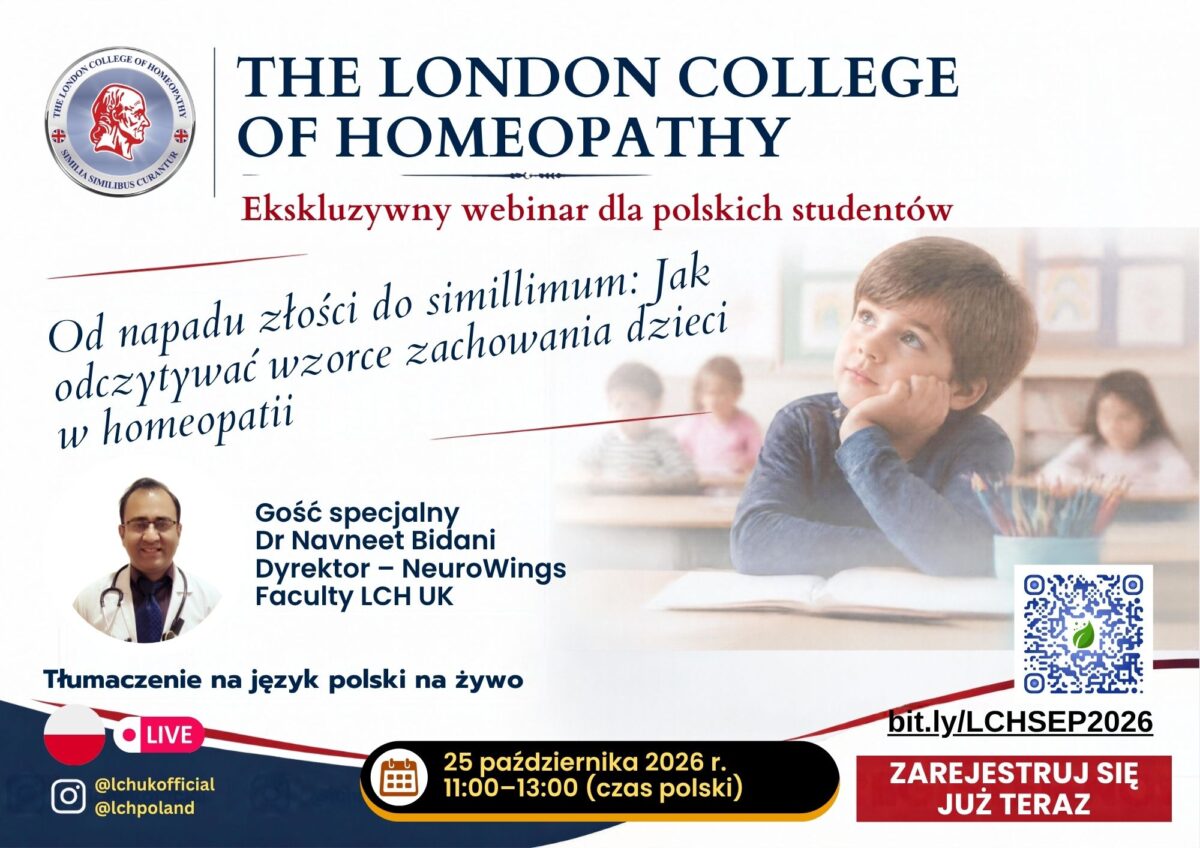
From Temper Tantrum to Simillimum – Polish Webinar by LCH UK

The London College of Homeopathy (LCH UK) is pleased to announce an exclusive clinical webinar tailored specifically for our Polish student community: “From Temper Tantrum to Simillimum: Decoding Paediatric Behavioural Archetypes in Homeopathy.”

The London College of Homeopathy (LCH UK) ma zaszczyt zaprosić całą polską społeczność akademicką i studencką na dedykowane seminarium kliniczne online: „Od napadu złości do simillimum: Jak odczytywać wzorce zachowania dzieci w homeopatii”.

Paediatric case-taking presents special challenges in both classical and clinical homeopathy. Non-verbal cues, emotional dysregulation, and behavioural manifestations often serve as the most reliable guides for identifying the true constitution and selecting the accurate simillimum. This interactive masterclass will investigate the semiotics of early childhood behaviour, examining how frequent outbursts, sensory sensitivities, and developmental archetypes correlate with repertorial rubrics and the materia medica.

Wywiad homeopatyczny u pacjenta pediatrycznego wymaga szczególnej wrażliwości diagnostycznej i wnikliwej analizy semiotycznej. U małych dzieci to właśnie ekspresja behawioralna, labilność emocjonalna, reakcje na bodźce oraz specyfika napadów złości stanowią kluczowe objawy przewodnie prowadzące do wyboru właściwego leku konstytucyjnego (simillimum). Podczas webinaru przeanalizowane zostaną kliniczne archetypy zachowań dziecięcych w powiązaniu z rubrykami repertorialnymi oraz współczesnym obrazem Materia Medica.

Keynote Speaker / Prelegent

We are privileged to host a distinguished clinician and educator / Wykład poprowadzi uznany ekspert kliniczny:

  • Dr. Navneet Bidani, Director, NeuroWings, Faculty Member, The London College of Homeopathy, UK

Dr. Bidani brings extensive clinical experience in neurodevelopmental, behavioural, and paediatric care, bridging the gap between classical homeopathic principles (Similia Similibus Curantur) and modern paediatric observations.

Dr Bidani to ceniony specjalista w zakresie terapii zaburzeń neurorozwojowych i behawioralnych u dzieci, łączący klasyczną metodologię homeopatyczną (Similia Similibus Curantur) z nowoczesnym podejściem klinicznym.

Event Details

  • Date: Sunday, 25 October 2026 / Niedziela, 25 października 2026 r.

  • Time: 11:00 – 13:00 CEST (Polish Time) / 11:00 – 13:00 (czasu polskiego)

  • Format: Live Interactive Online Webinar / Spotkanie online na żywo (Webinar)

  • Language: English with Simultaneous Live Polish Translation (Tłumaczenie na żywo) / Wykład w języku angielskim z profesjonalnym tłumaczeniem symultanicznym na język polski na żywo

  • Target Audience: Polish Homeopathic Students, Practitioners, and Academic Affiliates / Studenci homeopatii, adepci, praktycy i członkowie społeczności LCH Poland

Registration

Participation is complimentary for registered students, but pre-registration is required due to platform capacity limits. Please refer to the email sent to you for registration.

Uczestnictwo jest bezpłatne dla zarejestrowanych studentów, ale wymagana jest wcześniejsza rejestracja ze względu na ograniczenia pojemności platformy. Proszę odnieść się do e-maila wysłanego do Ciebie w celu rejestracji.

Nourishing Health: Exploring the Relationship Between Nutrition and Homeopathy

A summary of the London College of Homeopathy webinar with guest lecturer Monica Price

Introduction

Health is rarely the product of a single factor. It emerges from the interplay of diet, sleep, physical activity, stress, social connection, environment and medical care. This was the central theme of a recent webinar hosted by the London College of Homeopathy (LCH) UK, in which guest lecturer Monica Price, a health practitioner with over twenty years of experience in nutrition and complementary medicine, examined how nutrition and homeopathy can be understood as complementary strands within a wider, holistic approach to wellbeing.

The session, translated live in Turkish by Dr Gamze Arpacı, brought together students and practitioners to consider how two distinct disciplines—one concerned with nourishment, the other with individualised, symptom-based treatment—might inform one another in practice.

Defining the Territory: What Nutrition and Homeopathy Each Offer

Monica opened by distinguishing between the two fields. Nutrition, she explained, is concerned with how food supplies the body with the energy, vitamins, minerals and compounds required for growth, repair and normal biological function—extending well beyond calorie counting or body weight to encompass gut health, cognitive function and emotional wellbeing.

Homeopathy, by contrast, is a system of complementary medicine with a history spanning some two hundred years, rooted in the principle of “like cures like” and in individualised treatment using highly diluted preparations. Its origins were traced, in part, to the early writings of Samuel Hahnemann, whose observations on the connection between nutrition and health were referenced as an early precursor to the themes explored in the webinar.

Rather than presenting these as competing systems, the discussion framed nutrition and homeopathy as addressing different aspects of a person’s health—one focused on dietary patterns and physiological nourishment, the other on individualised symptom management—with clear scope for the two to complement one another within a person-centred model of care.

Evaluating Evidence in Complementary Healthcare

A significant portion of the webinar was devoted to how practitioners might evaluate different forms of evidence. Monica outlined the range of research methods applied to homeopathy, including clinical trials, observational studies and laboratory investigations, and posed a question to attendees: how should scientific research, clinical experience and patient-reported outcomes be weighed against one another when they point in different directions?

This question generated considerable discussion. Participants noted that responses varied across personal experience, clinical experience, scientific research and formal evidence reviews, with no single source of evidence identified as sufficient on its own. The consensus that emerged favoured a combined approach: practitioners should systematically collect and document patient experience while continuing to engage with the scientific literature, using both to refine practice over time.

The Practitioner-Patient Relationship

A recurring theme throughout the session was the significance of the consultation itself. Monica and Gamze discussed how sufficient time, attentive listening and a genuine sense of being heard can influence a patient’s experience of care, alongside the acknowledged role of the placebo response in perceived improvement. The discussion underscored that nutrition, supplements, herbal medicine, homeopathy and conventional medicine each warrant individual evaluation, rather than being grouped together as a single category of “alternative” treatment.

To illustrate this in practice, the group examined a case study involving a patient, Sarah, presenting with fatigue, poor sleep, digestive discomfort, high stress and irregular eating patterns. Attendees explored the kinds of questions a practitioner might ask to uncover underlying dietary, lifestyle and emotional contributors to her symptoms—reinforcing the point that better questions, not just more treatments, often lead to better outcomes.

Diet, Lifestyle and Individualised Practice

Monica shared reflections drawn from her own clinical experience, including the use of ketogenic and Mediterranean-style dietary patterns alongside homeopathic care for patients experiencing depression and bipolar disorder, and her focus on nutrition-led approaches for children with autism and ADHD. She described observing improvements in symptoms within a matter of weeks when processed foods and refined sugars were reduced in favour of a more balanced diet, while emphasising that such approaches should always be personalised to the individual, taking account of lifestyle, environmental exposure and specific food sensitivities.

Practical recommendations discussed during the session included:

  • Keeping a food diary to help identify patterns between diet and symptoms
  • Aiming for a nutrient-dense, varied diet rich in colourful, whole foods
  • Undertaking at least thirty minutes of physical activity each day
  • Trialling a gluten-free diet where gluten sensitivity is suspected
  • Maintaining balance and moderation, allowing for occasional indulgence alongside regular, healthy eating
  • Referring patients to appropriately qualified professionals when required

Towards a Holistic Model of Care

The webinar concluded with a broader reflection on what holistic healthcare means in practice. Rather than positioning complementary approaches in opposition to conventional science, the discussion framed holistic practice as a matter of asking broader questions—attending to the physical, emotional and lifestyle dimensions of a patient’s life, not only their presenting symptoms. Continuing professional development was also highlighted as central to this approach, with practitioners encouraged to keep learning, engage with professional networks, and systematically map patient experiences to inform their ongoing practice.

Conclusion

This session offered a considered exploration of how nutrition and homeopathy, while methodologically distinct, can come together within a person-centred approach to health. By examining the practitioner-patient relationship, the evaluation of evidence, and real-world case discussion, the webinar highlighted the value of individualised, well-informed practice—one that draws on multiple sources of insight to support patients as whole individuals rather than as a collection of symptoms.

LCH UK is a pioneer and accredited, UK-based institution providing structured and classical online homeopathic courses. To join one of our courses, you may visit the Courses section or drop an email at info@lchomeopathy.com.

Disclaimer: The information presented here is not medical advice / endorsement or a replacement for a doctor’s discretion of treatment. These tips are purely for information and discussion purposes only. Please seek appropriate medical advice from your nearest medical / health professional.

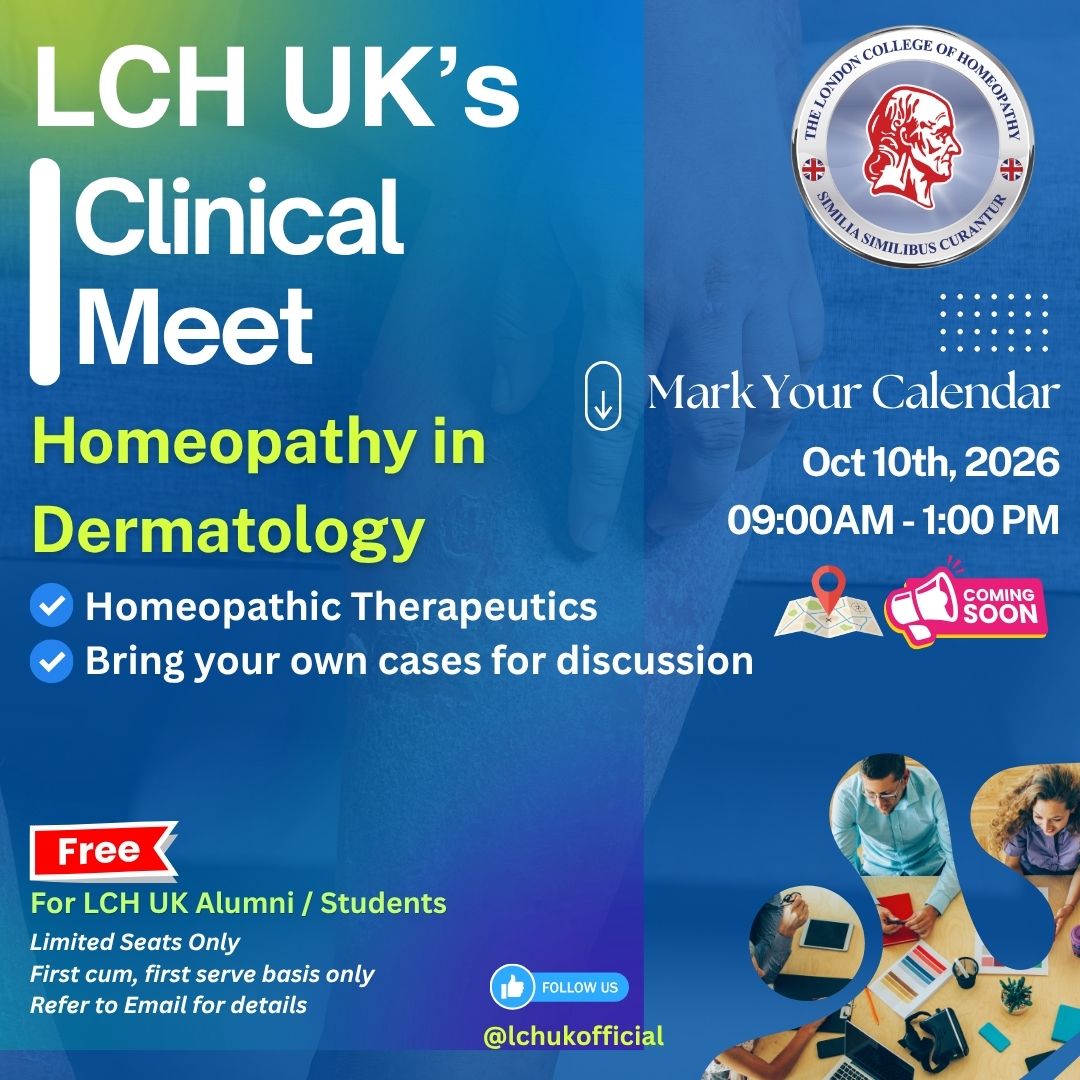
LCH UK Clinical Meet on Dermatology in Homeopathy

Hey, our students in London!

Be ready to join us at our in-person Clinical Meet on Homeopathy in dermatology!

Learn the therapeutics live and get ready to discuss the real cases.

And if you wish, you can bring your own cases for discussion.

  • Save the Date: 10th October 2026; 9-1pm
  • Location: Clayton Hotel Chiswick, London

Free for our students.

But hurry, as we have only limited seats!

Refer to the email sent to you for registration.

Come and learn the best of homeopathy.